
The Law That Forgot Military Families
Congress passed a unanimous hate crimes protection for soldiers and veterans in 2009. The government built everything it promised — for everyone else.

Congress passed a unanimous hate crimes protection for soldiers and veterans in 2009. The government built everything it promised — for everyone else.
In October 1998, a 21-year-old college student named Matthew Shepard was beaten, tied to a fence post in rural Wyoming, and left to die because he was gay. Five weeks later his mother testified before Congress. A decade of advocacy followed. In July 2009, the Senate voted to name a landmark hate crimes bill after Matthew Shepard and James Byrd Jr., a black man who had been chained to a pickup truck and dragged to his death in Jasper, Texas, before being beheaded. James was killed a few months before Matthew.
The vote was 63 to 28.
What almost nobody remembers is that tucked inside that same bill — added by Senator Jeff Sessions of Alabama and adopted by the full Senate 92 to zero — was a separate provision. It created a new federal crime: targeting a member of the United States military, a veteran within five years of discharge, or their immediate family member, because of their military service. Sessions called it the Soldiers' Amendment. He said its explicit purpose was to put military families "on equal footing with other protected classes."
Ninety-two to zero. In the United States Senate. That almost never happens.
President Obama signed the Matthew Shepard and James Byrd Jr. Hate Crimes Prevention Act into law on October 28, 2009. The Soldiers' Amendment became 18 U.S.C. § 1389.
Then the government got to work — for everyone else.
What Happens After a Law Is Passed
Most Americans have no idea what happens after Congress passes a law. The signing ceremony gets covered. The law gets filed. And then, mostly invisibly, an enormous amount of work either does or doesn't happen — work that determines whether the law means anything to the people it was written to protect.
For the communities covered by the main body of the Hate Crimes Prevention Act, that work happened. Understanding what was built for them is the only way to understand what was withheld from military families.
The FBI added new reporting categories. The national crime reporting system — which law enforcement agencies across the country use to submit hate crime data to the federal government — was updated to track offenses against every newly protected class. By 2013, police departments were reporting incidents motivated by anti-gender-identity bias. Religious bias categories expanded to include Sikhs, Hindus, Arabs, Mormons, and Jehovah's Witnesses. The infrastructure of counting made targeted communities visible. You cannot address what you do not measure, and the government understood this for every new class the law created.
Every new class except one.
The Justice Department's Community Relations Service expanded its jurisdiction. CRS is sometimes called DOJ's "peacemaker" — a little-known office that deploys to communities experiencing tension after bias incidents, helps victims understand their rights, builds relationships between targeted communities and local law enforcement, and does the outreach work that turns a law on paper into a resource people actually know how to use. After the 2009 Act passed, CRS formally expanded its jurisdiction to cover the newly protected communities — specifically LGBT communities and the disability community. A named national program manager was assigned to serve Muslim, Arab, South Asian, Sikh, and Hindu communities specifically.
After a white supremacist walked into a Sikh temple in Oak Creek, Wisconsin in 2012 and killed six worshipers, CRS deployed. It facilitated awareness trainings for Sikh and Muslim communities, established dialogue between community leaders and law enforcement, and ensured that the people most likely to be targeted next knew they had federal protection and knew how to access it. After Dylann Roof murdered nine Black parishioners at Emanuel AME Church in Charleston in 2015, CRS deployed again.
No equivalent program, position, or deployment has ever existed for military families.
DOJ launched a dedicated hate crimes website in 2018, cataloguing federal prosecutions, listing protected categories, and providing reporting guidance. Military and veteran status does not appear on it. This is not a matter of interpretation or inference — it is documented.
DOJ was sent two Congressional inquiries, one from each Legislative chamber. In November 2019, Representative David Trone of Maryland circulated a letter to AG William Barr and FBI Director Christopher Wray, joined by five House colleagues.
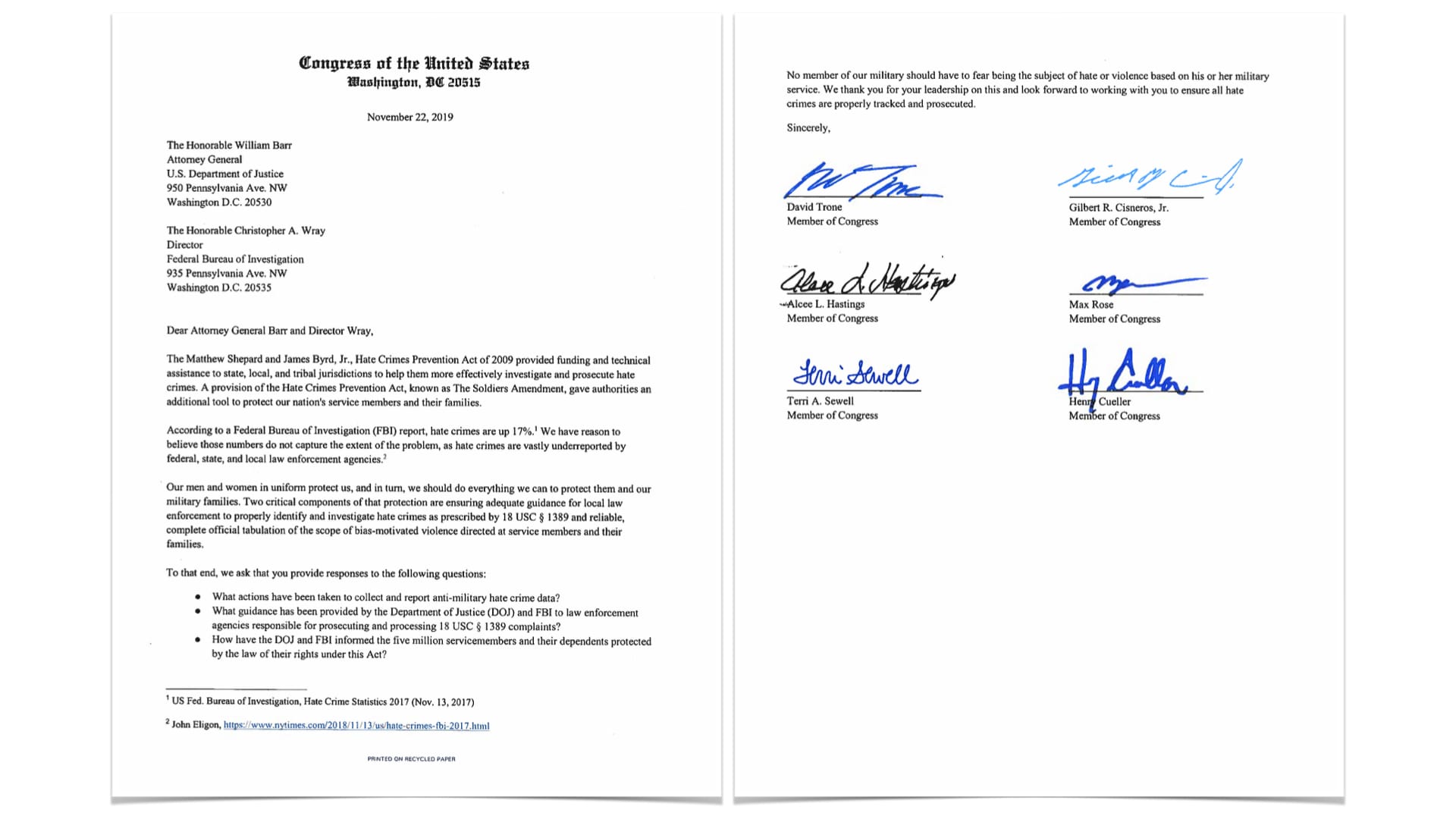
The six House Democrats asked the Republican-controlled executive agency what data collection had been done, what guidance had been provided to law enforcement, and how DOJ and FBI had informed the five million servicemembers and their families of their rights under the Act. No public response was ever issued.
Nearly five years later, on October 4, 2024, Senator Ron Wyden of Oregon sent a similar letter to President Biden's AG, Merrick Garland, quietly, without press release or public announcement, while serving as Chairman of the powerful Senate Finance Committee. It went unanswered.
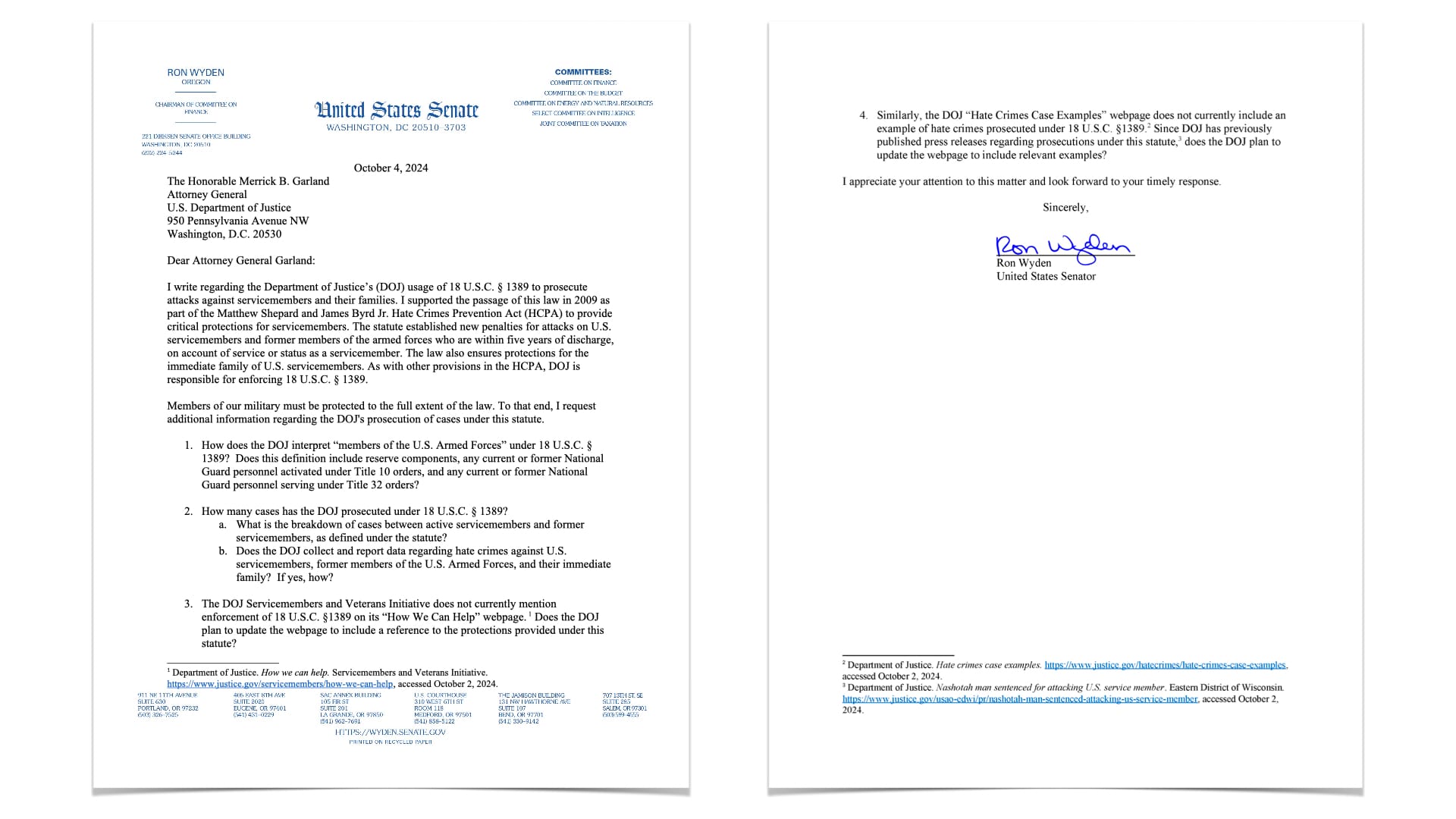
Two Congressional inquires. 17 lives every day. Zero accountability.
DOJ created a Hate Crimes Enforcement and Prevention Initiative drawing together prosecutors from the Civil Rights Division, FBI agents, U.S. Attorneys, community policing specialists, and CRS representatives. It produced the Law Enforcement Roundtable Report on Hate Crimes, the stated goal of which was to assist state and local law enforcement, support communities impacted by hate violence, and prosecute cases at the federal level. Military families have no documented seat at that table.
The result of all this infrastructure — the reporting categories, the community outreach, the dedicated staff, the website, the working group — is a pipeline. A victim in a protected community learns they are protected because their community organization tells them so. They report an incident because they know how and where to report. Local law enforcement flags it as a potential federal hate crime because they have been trained to do so. The data gets counted because there is a box to put it in. Federal prosecutors know the statute exists because it appears in their training materials and charging frameworks.
That pipeline — from victimization to awareness to reporting to prosecution — is what transforms a law from a promise into a protection.
Military families never got the pipeline.
What the Government Missed — On the Record
On November 13, 2019, two days after Veterans Day and about a week before Trone's DoJ inquiry, the U.S. Commission on Civil Rights — the independent, bipartisan federal agency charged with monitoring civil rights enforcement and reporting to Congress — published a 310-page report titled In the Name of Hate: Examining the Federal Government's Role in Responding to Hate Crimes.
The Commission held a public briefing, heard from federal and local law enforcement, policy makers, community leaders, and family members of hate crime victims. It examined every aspect of the government's implementation of the 2009 Act.
It produced four detailed tables cataloguing every federal hate crime prosecution DOJ had brought since the Act passed — organized by protected category. Table 5: Race, Ethnicity, and National Origin. Table 6: Gender Identity and Sexual Orientation. Table 7: Religious Animus. Table 8: Disability.
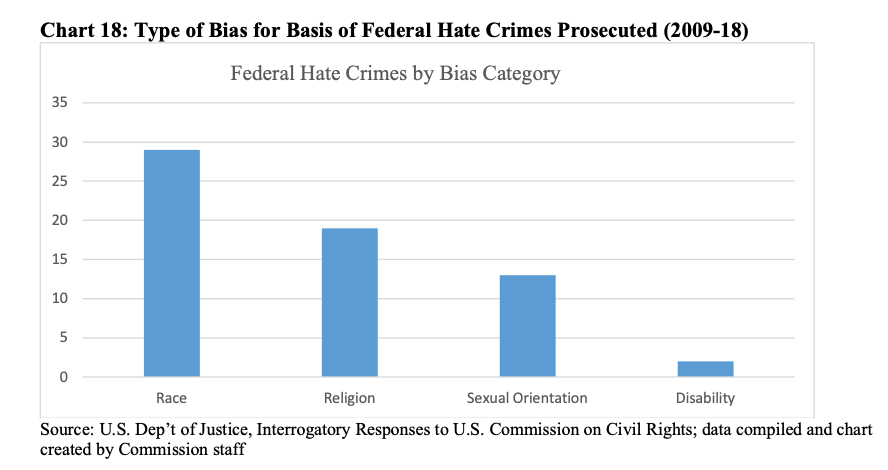
There is no Table 9. Military and veteran status does not appear anywhere in 310 pages — not in the findings, not in the recommendations, not in any prosecution table.
This would be unremarkable — an oversight by an independent agency — except for one detail. In footnote 87, the Commission cited the underlying statute correctly: Matthew Shepard and James Byrd, Jr. Hate Crimes Prevention Act of 2009, Pub. L. No. 111-84, §§ 4701-4713, 123 Stat. 2835 (2009).

Sections 4701 through 4713. The Commission had the full Public Law in hand. Section 4712 — the Soldiers' Amendment, the provision that became 18 U.S.C. § 1389 — is right there in the citation. And then, in the same footnote, the Commission collapsed the entire Act into a single codification: "codified at 18 U.S.C. § 249."
That is not accurate. § 249 is the main hate crimes provision. § 1389 is a separate codification of § 4712. The Commission cited a law that covers military families and then wrote 310 pages as though it didn't.
This is not an accusation of bad faith. It is something more troubling: even the body specifically charged with oversight of federal civil rights enforcement looked directly at the Soldiers' Amendment and did not see it. That is precisely what happens when there is no reporting infrastructure, no community outreach, no advocacy pipeline, no data — when a protected class has been made invisible by institutional neglect, even the watchdog goes blind.
When the Law Was Needed and Wasn't There
On May 11, 2015, a 23-year-old Cincinnati man named Munir Abdulkader was in electronic communication with Junaid Hussain, a known ISIS operative based overseas. The plan they discussed, documented in federal court records, was specific: raid the home of a specific soldier — Abdulkader had requested someone who had deployed to Iraq or Afghanistan — behead him, record it, send the video to Hussain for use as ISIS propaganda, steal the soldier's uniform, then use it to walk casually into a Cincinnati police station and kill as many officers as possible.
Abdulkader asked Hussain to provide the soldier's name, address, and personal information. He was specific about what he wanted: "Make sure the soldier was in Iraq or Afghanistan."
Ten days later, on May 21, Abdulkader purchased an AK-47 assault rifle and was arrested. The intended victim — whose identity has never been made public — was never harmed.
Abdulkader was charged with conspiracy to kill a government employee, possession of a firearm in furtherance of a crime of violence, and providing material support to a designated foreign terrorist organization. He pleaded guilty and was sentenced to twenty years in federal prison.
He was never charged under 18 U.S.C. § 1389.
The law Congress passed in 2009 — specifically to make targeting a soldier a federal hate crime — was sitting in the United States Code when Munir Abdulkader sat in a Cincinnati apartment and asked an ISIS operative for a veteran's home address. It was not used. There is no public record of it being considered.
Abdulkader is not an isolated case. Mufid Elfgeeh, a New York pizza shop owner, purchased a firearm and silencer in 2014 with plans to murder a regular customer who was serving in the Army. He was arrested and prosecuted on terrorism charges. Not charged under § 1389. Hasan and Jonas Edmonds, cousins in Illinois, were arrested in March 2015 for a plot to attack a military base. Not charged under § 1389. Terrence McNeil, an Ohio man with no prior criminal record, published the personally identifying information of approximately 100 servicemembers on social media in November 2015 alongside calls for their murder, identifying himself as an ISIS supporter.
McNeil is among the meager handful of documented cases in which § 1389 has ever been charged. Prosecutions under the statute are so rare that a sitting U.S. Senator could not get a straight answer from DOJ about how many had occurred — which is itself part of the record. What is clear is that in the years immediately following the law's passage, when the pipeline for other communities was being built and cases were being brought, § 1389 sat effectively dormant.
One case. In sixteen years.
The Arson Nobody Could Explain
Not every failure involves terrorism. On July 4, 2010 — Independence Day, eight months after the Soldiers' Amendment became law — the American Legion Post 10 in Albany, Oregon, was burned to the ground in a three-alarm fire. It took five months and the assistance of federal agencies for local law enforcement to arrest Trent Allen Fox.
Fox passed a mental examination and took a plea deal. He avoided trial. Members of American Legion Post 10 never learned why their hall was burned.
The Soldiers' Amendment had been law for eight months. Whether it applied to Fox's case — whether his motive was animosity toward veterans specifically — was never examined in court, because the plea deal foreclosed it. Whether local law enforcement or federal investigators ever considered § 1389 as a potential charging vehicle is unknown. Whether they had even heard of it is unknown.
That is what the absence of a pipeline produces. Not just unenforced law — unanswered questions. A community of veterans who rebuilt their hall and never got an explanation. A statute that existed to protect them, unmentioned in any proceeding.
Why There Are No Complaints
The most common response to this story, when people hear it, is a question: if military families were being targeted, wouldn't there be complaints? Wouldn't someone have reported something?
The question answers itself.
How would a military family member know to report a hate crime under a federal law they have never heard of? How would a local police officer know to flag an incident as potentially falling under a statute that does not appear in any reporting system, any training material, or any charging framework they have encountered? How would a federal prosecutor think to reach for § 1389 if it is absent from DOJ's own hate crimes website, absent from the working group's agenda, absent from the categories their data systems track?
The communities that received the full benefit of the 2009 Act received it because the government built a pipeline: awareness, reporting, data, prosecution. Each stage feeds the next. CRS told communities they were protected. Communities told their members. Members reported incidents. Local law enforcement flagged them. Federal prosecutors charged them. The data got counted. Researchers analyzed it. Advocacy organizations used it to push for more resources.
None of that happened for military families. There are no complaints in DOJ's files not because nothing has happened to military families, but because there was never a mechanism for them to report it — and because the community was never told, officially or otherwise, that the law existed.
In March 2026, a formal request was filed under the Freedom of Information Act demanding that DOJ produce any records showing what, if anything, it has done with the Soldiers' Amendment since 2009. What complaints has it received? What internal guidance has it produced? What does DOJ even believe its own jurisdiction is under this law?
As of this writing, the case is pending in federal court. DOJ has not answered.
What Ninety-Two to Zero Actually Meant
Senator Sessions said the purpose of his amendment was to put military families "on equal footing with other protected classes." Senator Carl Levin, the Democratic chairman of the Armed Services Committee, rose in support and said simply: "We should do everything we can when it comes to our criminal laws to protect them and their families."
Ninety-two senators agreed. Zero dissented.
What equal footing required was not complicated. It required the same things the government built for every other community the law covered: a reporting category, a community relations presence, a program manager, a line on a website, a seat at the working group table, a place in the training materials. The infrastructure of being counted, known, and protected.
None of it was built.
Matthew Shepard and James Byrd Jr. deserved better than what happened to them. The country responded — imperfectly, a decade late, but meaningfully — with a law in their names.
Military families were included in that law. They are still waiting for the response.
A federal FOIA enforcement lawsuit, Isaac v. United States Department of Justice, Case No. 6:26-cv-00832-MTK (D. Or.), is currently pending before Judge Mustafa T. Kasubhai in the Eugene Division of the District of Oregon. The suit seeks records from DOJ's Civil Rights Division and National Security Division concerning any enforcement activity, internal guidance, or complaints received under 18 U.S.C. § 1389 since 2009. Further information is available at gijustice.com.