
Who Holds the Receipts?


What a philosophy conference paper has to do with "thank you for your service"
Last month I presented a paper at the International Academy of Practical Theology's annual conference at the University of Chicago Divinity School. The paper has a title that sounds like it belongs behind a paywall — The Receipts Democracy Can't Discard: Marginalized Communities, Semiotic Realism, and the Limits of Dewey's Democratic Inquiry — and in some sense it does. But the argument underneath the title is one I've been living, not just writing, and it translates pretty directly into things most of you already know from your own lives.
Here's the short version.
The problem with "widest inclusion"
John Dewey was one of America's most important philosophers. He argued that a healthy democracy advances through the widest possible inclusion of diverse experience — that the more voices at the table, the closer we get to the truth. It's a genuinely compelling idea, and it's the intellectual ancestor of almost every progressive democratic ideal you've ever heard.
The problem is that Dewey's framework has a blind spot built in. It assumes that democratic communities are in principle self-correcting — that if we just get better at including people, the system will eventually catch up to its own stated values. What it can't account for is that the community of inquiry is already structured by who has been paying the costs and who has been collecting the benefits before anyone sits down at the table. You can't fix a frame from inside the frame that was built to conceal the problem.

Here's the telling biographical detail: Dewey was a founding member of the NAACP. He stayed after W.E.B. Du Bois left — and Du Bois left precisely because the organization was managing Black inclusion on the dominant community's terms rather than reckoning with what real inclusion would cost. Dewey, the philosopher of the widest inclusion of diverse experience, never publicly asked why his peer left. The silence wasn't personal. It was structural.
The receipt you can't throw away
Every benefit has a cost. Somebody always pays. And the communities that pay — that bear the weight of a common life from which they are excluded from the benefits — develop a particular kind of knowledge that the communities collecting the benefits cannot replicate.
I call these communities the receipts democracy can't discard. Their continued existence is the record of the debt. You can shuffle the receipt to the back of the drawer. You can pretend it isn't there. But you can't throw it away without losing your grip on what things actually cost.
W.E.B. Du Bois named this dynamic in the African American experience with what he called double consciousness — the enforced capacity to see yourself through the eyes of a community that defines you as a problem while also seeing what that community cannot see about itself. He framed it as a wound, and it is. But the paper argues that it's also something else: a perceptual advantage. The person who has to navigate two meaning systems simultaneously — the dominant one and their own — cannot mistake the dominant one for reality itself. They know it's a framework, because it presses back against them every day.
That's not a small thing epistemically. It means the communities that have been paying the costs are, in a precise and documentable sense, the more reliable witnesses to what the common life actually is. Not because suffering makes you wise, but because you can't afford the luxury of self-deception that comes with never having to examine the system from outside it.
The civil rights movement most people don't know
Here's where it gets concrete.
The legal infrastructure of the civil rights movement — the cases that made everything else possible — was built by military families and veterans, not by the civilian intellectuals and clergy who became the movement's public face.
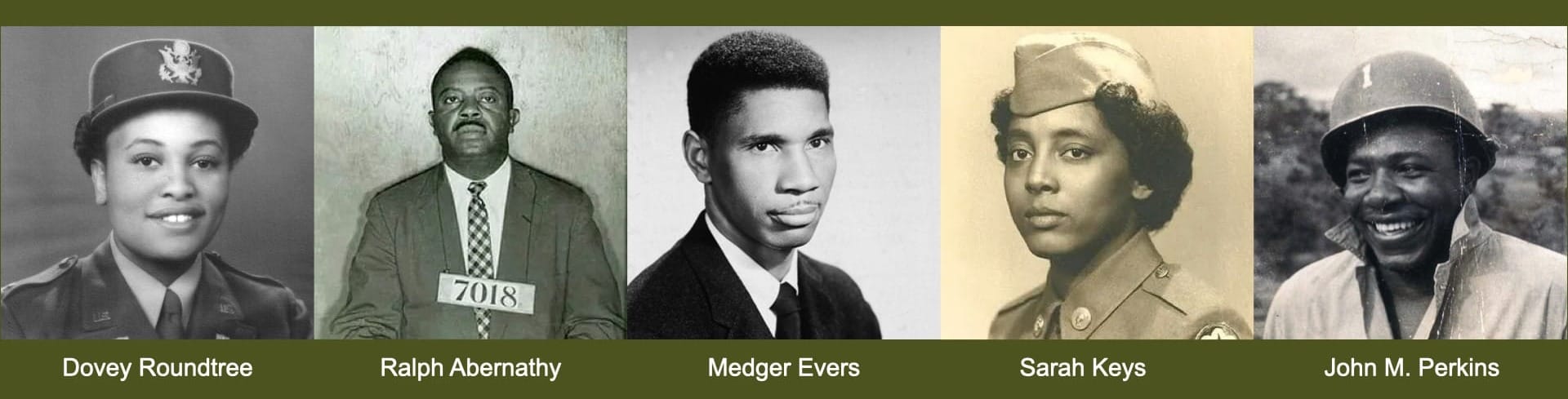
Irene Morgan, a defense contractor who built B-26 Marauders in Baltimore, refused to give up her bus seat in 1944 and won the first major civil rights legal victory. Oliver Leon Brown, a WWII veteran and pastor in Kansas, became the named plaintiff in Brown v. Board of Education. Sarah Keys, daughter of a Navy veteran, refused to yield her seat to a White Marine in 1952, and her case before the Interstate Commerce Commission established the legal foundation that made Montgomery possible. Rosa Parks made her decision one month after Keys won — standing, literally, on the shoulders of soldiers.
This genealogy was progressively displaced as the movement achieved its statutory victories and civilian figures whose advocacy was more legible to mass media took the public stage. The martial epistemology — the specific knowledge forged by people who had volunteered to defend freedoms they were actively being denied — couldn't be absorbed without reckoning openly with what it cost. So it was set aside. Not settled. Just relocated.
 Logan Martin Isaac
"Thank you for your service" is a receipt management strategy
In the present tense, the same mechanism operates through the attention economy.
Veterans who align with progressive coalition politics — advocating for other protected communities — receive platform and amplification. Veterans who try to claim civil rights protections for their own community find their work characterized as ideologically suspect or divisive. The veteran is welcomed as a moral prop. The veteran as rights-claimant in their own name threatens the coalitional arrangements that keep the advocacy infrastructure legible and funded.
"Thank you for your service" is the ritual performance of a debt without its examination. It acknowledges the obligation in a form that forecloses the question rather than opening it. The philosopher Charles Peirce called this the method of tenacity — fixing your beliefs in a way that avoids the discomfort of genuine inquiry. In this case: fixing belief in the veteran's gratitude and the civilian's generosity, so no one has to ask what the debt actually requires.
The Soldiers Amendment — Section 4712 of the Hate Crimes Prevention Act, passed unanimously by Congress in 2009, explicitly extending equal protection to soldiers and veterans — has never been meaningfully enforced. It exists in the same structural position as the Interstate Commerce Commission ruling after Morgan v. Virginia: acknowledged in the abstract, refused in practice.
Veterans have been dying by suicide at a rate significantly higher than the civilian population since at least 2009. The rate has not meaningfully declined despite nearly two decades of funded intervention. The dominant community absorbed this into the category of mental health, which privatizes the problem and prevents examination of the structural conditions that produce it.
The suicide rate is what an unexamined receipt looks like when it is a person rather than a ledger entry.
Why this matters outside the tower
The philosophical argument in the paper is about epistemology — about who knows what, and why structural position rather than individual virtue is what generates reliable knowledge about the actual costs of common life. But the claim underneath the philosophy is one most of you already know from the inside.
The communities that pay — veterans, yes, but also the communities Du Bois was describing, and before that the Samaritans, and the labor movement, and every community whose existence testifies to a debt the dominant culture can neither examine nor discard — are not voiceless because they lack insight. They are voiceless because receiving their testimony honestly would require the dominant community to examine what it has been costing someone else to maintain the current arrangement.
The receipts don't disappear when they're misplaced. They accumulate.
The unasked question isn't really about philosophy. It's about who gets to name the problem, who gets to define what solving it looks like, and whose silence is mistaken for consent.
Are you working in academia, publishing, or research and want to develop these themes further? I'm looking for collaborators, reviewers, and conversations — get in touch at logan@pewpewhq.com.