Isaiah 6 Artistic Intertexts


Submitted on March 22, 2011, to Anathea Portier Young in partial fulfillment of Intro to Old Testament Interpretation (OT12).
Girard Picart & Isaiah 6
For this assignment, I have decided to stick with the same scripture I used for my Exegetical Brief and Prophetic Sermon, Isaiah 6. The prophetic office has been very interesting to explore, so I figured I would go deeper. The chapter describes the call of Isaiah of Jerusalem, whose ministry occurred early in Israel’s history, right around the time of the Syro-Ephramite Crisis. Isaiah’s commissioning vision is the first prophetic calling of its type, describing a vision with elements that are doxological; confession (“I am a man of unclean lips”), ritual (instead of bread and wine, a burning coal from the altar), absolution, (“your guilt is taken away, and your sin forgiven”), offertory, (“Here am I! Send me.”), etc. The artwork I settled on is an engraving by Girard Picart, a Frenchman living in the 18th century. Picart crafted this particular image for a book titled Figures de la Bible, published in 1728 by P. de Hondt. At first glance, I mistook it for a Gustave Dore, whose art I find appealing, but some research revealed that the styles were simply very similar (each being engravers). I found that the art and the passage seem to make a point to start with God before moving to the subject of the passage, Isaiah and his commissioning.
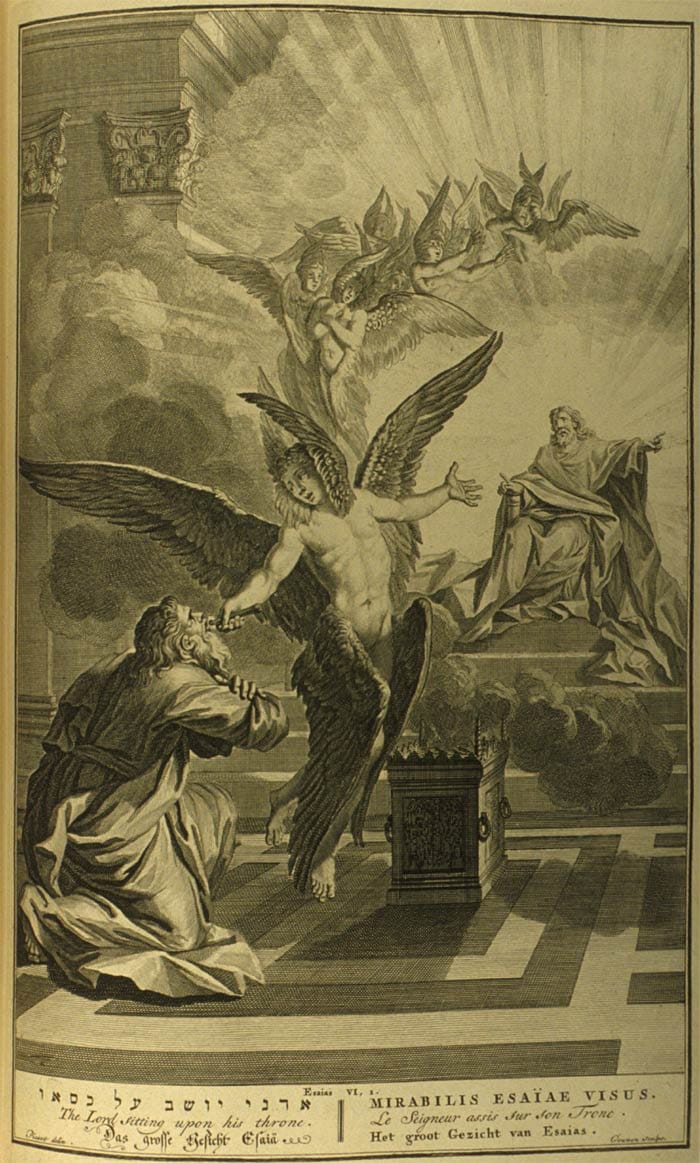
I was struck by the grandeur and drama Picart’s engraving gives the passage. He has read the passage closely, including the figure of God, which I think it important. In other pieces I found for this passage, they refuse to depict God, but it ignores the fact that Isaiah does in fact see God, it is what prompts his woe in verse 5. Furthermore, I like how lifelike Picart makes his characters, it adds to the reality and gravitas for me; the wings look like wings, the tongs look real, even the altar looks realistic. This, for me, hedges against the idealizing and superfluous venerating (for lack of a better word) that sometimes occurs with a holy text; the overuse of symbols that seems to spiritualize the vision more than is needed. This art reminds me that this could very well be something that a person witnesses in a vision, it’s not something totally abstracted from lived human experience. This is probably why I like it so much, it puts flesh back on the Bible for me, undoing the distancing that can happen when we put too much into a sacred text.
After reviewing the piece at length, I realized I may have been viewing it in reverse order. My eyes were drawn to the light along the right side, emanating from the figure of God. I think this reverses the tendency to begin with the largest (and therefore, closest) item in the art, which in this case would be the Prophet having his lips cleansed by the hot coal. Instead, my eyes started with where there was the most light, God upon the throne, and moved in a kind of Nautilus arch; from God upward to the seraphim, moving majestically down to the seraph holding the tongs, and finally to the prophet himself. I had moved from what was in the background to what was in the foreground. But in this case, I wonder if that was intended, since God should always be our theological starting point. In the passage, this order is replicated; it begins with God in the temple, surrounded by seraphim calling out to one another “Holy, Holy, Holy is the Lord of Hosts”, before the author turns the attention to the prophet and the cleansing ritual involving the coal from the altar. The author as well as the artist focuses our attention on God before allowing us to consider them. This is more certain in the passage, where it is clearly a linear process, we can track how the author moves in this order simply by following their use of language. With the art, however, I am left to wonder if in fact my eyes’ attraction to the light more so than the foreground was something internal, or if it was the artist’s intent after all. Either way, I appreciated the depth the art brought to the written word. I got a sense of grandeur and drama that reading alone did not leave with me. Especially with the way Picart was able to capture the expression on the seraph’s face and the realism with which he depicted the smoke from the altar, and other fine details, his attention and care gave a vibrancy and depth for which I am grateful.