
Peace Is a Racket: Naming the Activist Industrial Complex

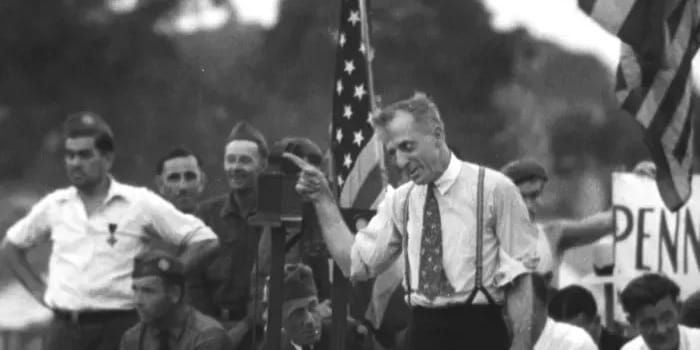
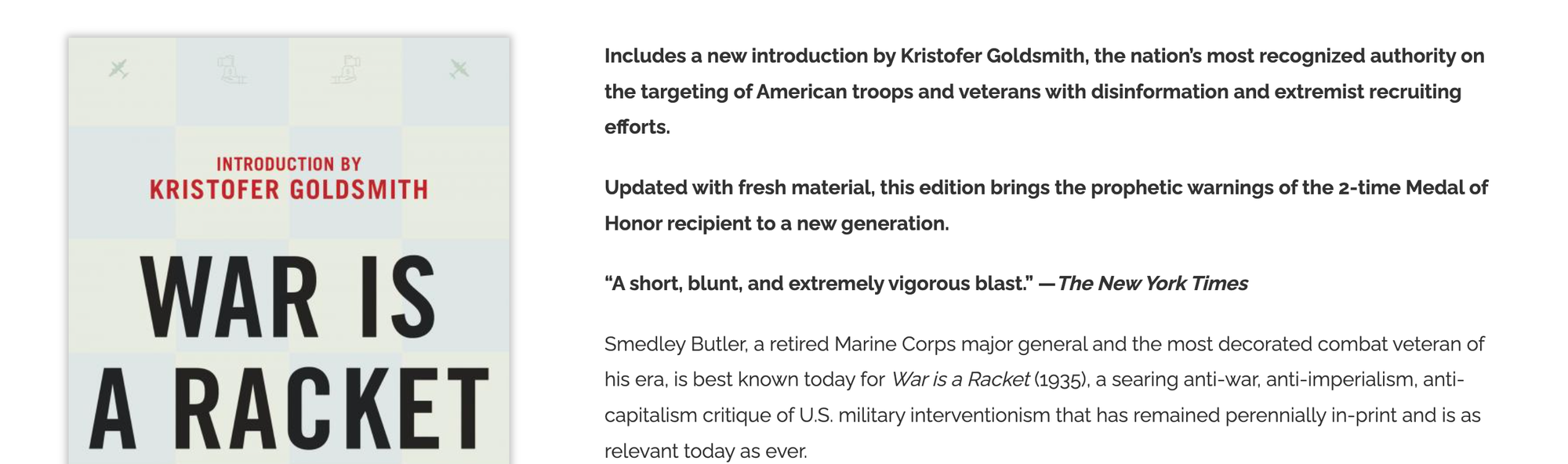
General Smedley Butler wrote “War is a racket” in 1935. The new Steerforth edition of his book, published September 22, opens with an introduction by Kristofer Goldsmith, whom the publisher calls “the nation’s most recognized authority on the targeting of troops and veterans with disinformation.” That’s marketing copy, not my verdict.
This month MS NOW reported on a sailor who jumped from the USS Abraham Lincoln’s flight deck in August, in what his wife describes as a suicide attempt. According to her, he was later found guilty of “jumping from a vessel” and “malingering” and given an oral reprimand. The Navy declined to discuss his record, and said suicide attempts are not, by themselves, punishable misconduct. The same story reports that Goldsmith received an Article 15 for malingering in 2007, after his own attempt, and by his account never got the court-martial he demanded.
Same charge, nineteen years apart, with a federal law, the Brandon Act, in between. And the people closest to the problem are handing out flyers at a pier so sailors know the law exists. That's a start, but information alone rarely moves the needle. I know from experience, not only from direct experience combating the system in court, but also from within the celebrity-driven peace racket Kris and I were both formed by. Whereas that industry drove me out for straying from their talking points, Kris has learned to profit off the complex relationship America has with what Twain called the "idols of our hearts."

The racket
Butler’s definition of a racket is something that is 1) not what it seems to most people, 2) run for the benefit of the few, at 3) the expense of the many. That defines the vast majority of the peace activism I’ve encountered in my life (and, as a combatant-turned-objector, it’s a lot). However, to call all celebrity activism “fake” is too broad to be true. My concern is narrower: there is an economy built around veteran suffering, and its revenue does not depend on whether that suffering decreases. Attention is the currency, not effect. Veterans are the commodity that garner racketeers the currency in which they trade. The organizations, publishers, and influencer platforms are the traders in a decidedly not-free market. When “peace” workers industrialize, the movement that once simply had to eat now requires a suit-and-tie job. Jobs, in the professional “non-profit” labor market, need clients. Or, in the case of enterprise-scale Charity, donors.
The confession
I’m not writing from the bleachers. Butler called himself a racketeer for capitalism, and the confession was the source of his authority. So here is mine: from 2006 I lent my "progressive" bona fides to Sojourners, Red Letter Christians, Veterans of Foreign Wars, HillVets, the list can go on. I thought I was getting support, advocacy, camaraderie, or some combination of the three. What I can say, in retrospect, however, is that what I was really providing was my time and energy, my email for data harvesting, and a fresh face to someone else's revenue-generating narrative. When I started doing civil rights work that cost industrial activists their currency, their tactics were almost always some version of Deny, Accuse, and Reverse Victim and Offender (DARVO).
I’m not telling this as a victim, I volunteered. But if that's on me, then it's also on them; the first economy I was drafted into was to fight wars, the second was to fight war hawks. In both, I was in service to (social) capitalists bleeding the military community drier than Ezekiel's valley of bones. They extract from the social pyramid scheme but wash their hands as soon as cracks begin to show.
 Logan Martin Isaac
How it runs
Nobody in this economy has to run an outright con. The booker needs a compelling veteran voice. The editor needs a redemption arc. The nonprofit needs a program a funder can understand, and the donor class gets a deduction and some warm and fuzzies. Each role is reasonable on its own terms, so long as there is enough plausible deniability, just enough alienation from the full truth. The peace racket, like any organized corruption, lives in how the roles interlock covertly, and in whose interests (justice, policy change, care) get deferred whenever they’d cost the organizers something.
An illustration, with a disclosure
Which brings me back to Kris. Disclosure first: he and I have history. He once called my military civil-rights work a “crusade” and meant it as an insult, and later called me a coward for expressing myself from within our shared military experience, which in 2018 was looking a lot like marginalization. So his advocacy for veterans has its limit. Weigh what follows accordingly.
 Logan M. Isaac
What he was doing at that pier is real work, and I’m not accusing him of faking anything - it is as real as the work we both did on behalf of IVAW. What interests me is what the system does with a person like him to maintain work that doesn't produce results. A publisher confers the title in a blurb. A network books the segment. That’s what I mean by any court-appointed "truth" teller: authority conferred by the act of booking, from the top down, instead of power from the bottom up. In 1 Kings 22, four hundred prophets tell a king what he hopes to hear, and the one who doesn’t fall in line is jailed. The problem wasn’t that each of them lied. It was that credibility had become industrialized from above, the ones who've seen some hard shit are comfortably passed over in favor of partial truths. Veterans who can't name the truth are just playing the game they were handed. My problem with that is it's the same game that kills 17 of us every day.
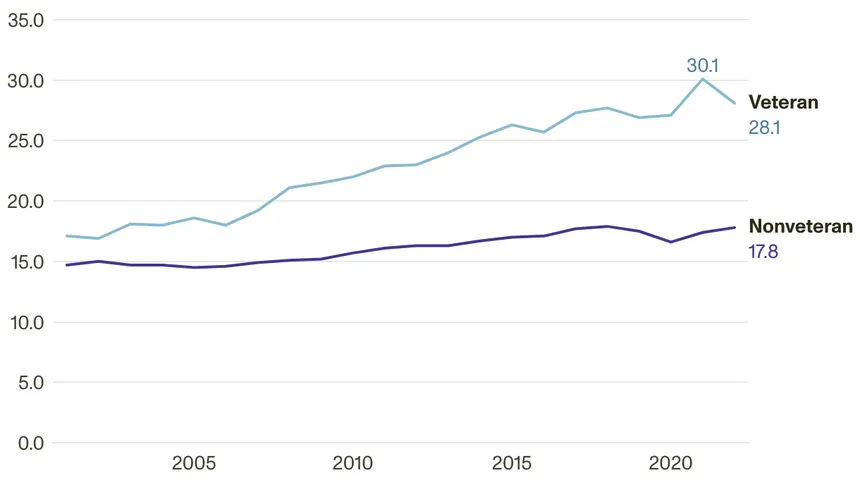
I can’t tell you someone like Kris seeks the microphone or if the microphone just happens to find him, but the racket doesn’t need to know; it just needs truthiness to be propagated by token veterans willing to stay on message. A more prophetic test is whether the message ever costs the booking. Or, more practically, whether the work has had any effect. If progressive activism included reducing military suicides, then the numbers suggest progressive activists really suck at their work. What's more likely is that solidarity and human dignity weren't centered to begin with, that the movement actually runs on another, more universalizing currency, like money.
A racket is a corrupting economy that profits a few by quietly appropriating the prophetic voices. Rackets survive by suppressing contrasting perspectives in order to minimally maintain plausible deniability. Peace is a racket because pacifism pays out in staff salaries rather than results. Court theologians get their needs met because they're on the take. Others? Never heard of 'em!
What would break it
Butler proposed three structural reforms. I’ll propose one. Those persons who bear the heaviest cost, must have a full seat at the table. Not advise from arms distance, not appear in the marketing without seeing the proceeds: the same social capital the activist industrial economy runs on. Everything else is just a better-funded version of the capitalist economy Butler rebuked, who'd be turning in his grave at the news that a professional veteran capitalizes on his work while battle buddies continue offing themselves in ever-increasing numbers.
Butler counted war’s profits in dollars and its losses in lives. If the dominant economy cared, there would be evidence. When peace industry insiders claim ignorance, that's just part of the game. The rules are simple: chase the mic, dodge some questions, then move on to the next ¢lick-bait sob $tory. That's how you know that peace is a racket, because it survives on money rather than measurable progress.