
The Feds Aren't Protecting the Military Community. They're Telling It to Disappear.


This week the Department of the Navy sent a message to 340,000 active-duty sailors, 58,000 reservists, and 210,000 civilian employees, plus their families. The message was not "we have this." It was: hide.
 Derricke Dennis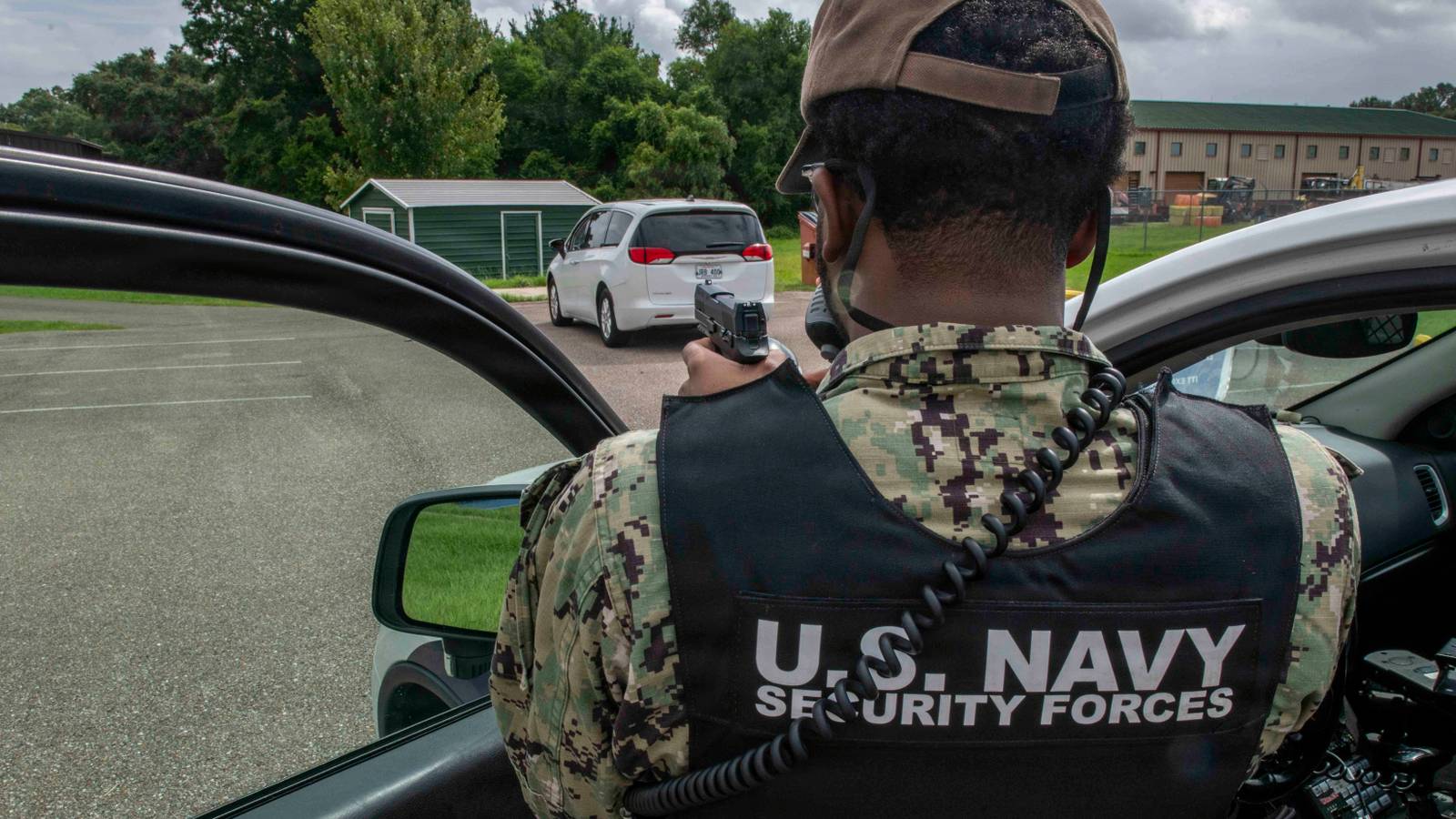
The notice, titled "Epic Vigilance: Immediate Actions for Force Protection and Personal Security," asks Navy personnel to review every social media account in the household — including their kids' — and strip out anything that could identify a connection to the Department of the Navy. Set profiles to private. Remove your patterns of life. Report anyone who lingers near a gate too long, asks too many questions, or shows up with a camera. The notice describes what it's responding to in plain language: doxing, harassment, off-base confrontation, imposter accounts, surveillance, "coordinated harassment campaigns designed to test security responses and personnel endurance."
That is not vague anxiety. That is a federal agency, in writing, telling nearly two-thirds of a million people that being publicly known as military-connected is now a liability to be managed by disappearing.
Here is what should trouble every reader of that notice, whether or not they wear a uniform: Congress already answered this question. In 2009, as part of the Matthew Shepard and James Byrd Jr. Hate Crimes Prevention Act, lawmakers added the Soldiers Amendment — now codified at 18 U.S.C. § 1389 — making it a federal crime to assault, batter, or destroy the property of a servicemember or their immediate family "on account of" their military status. The provision was sold on the floor as putting "members of the U.S. military on on equal footing" with race, religion, and the other classes the same law already protected.
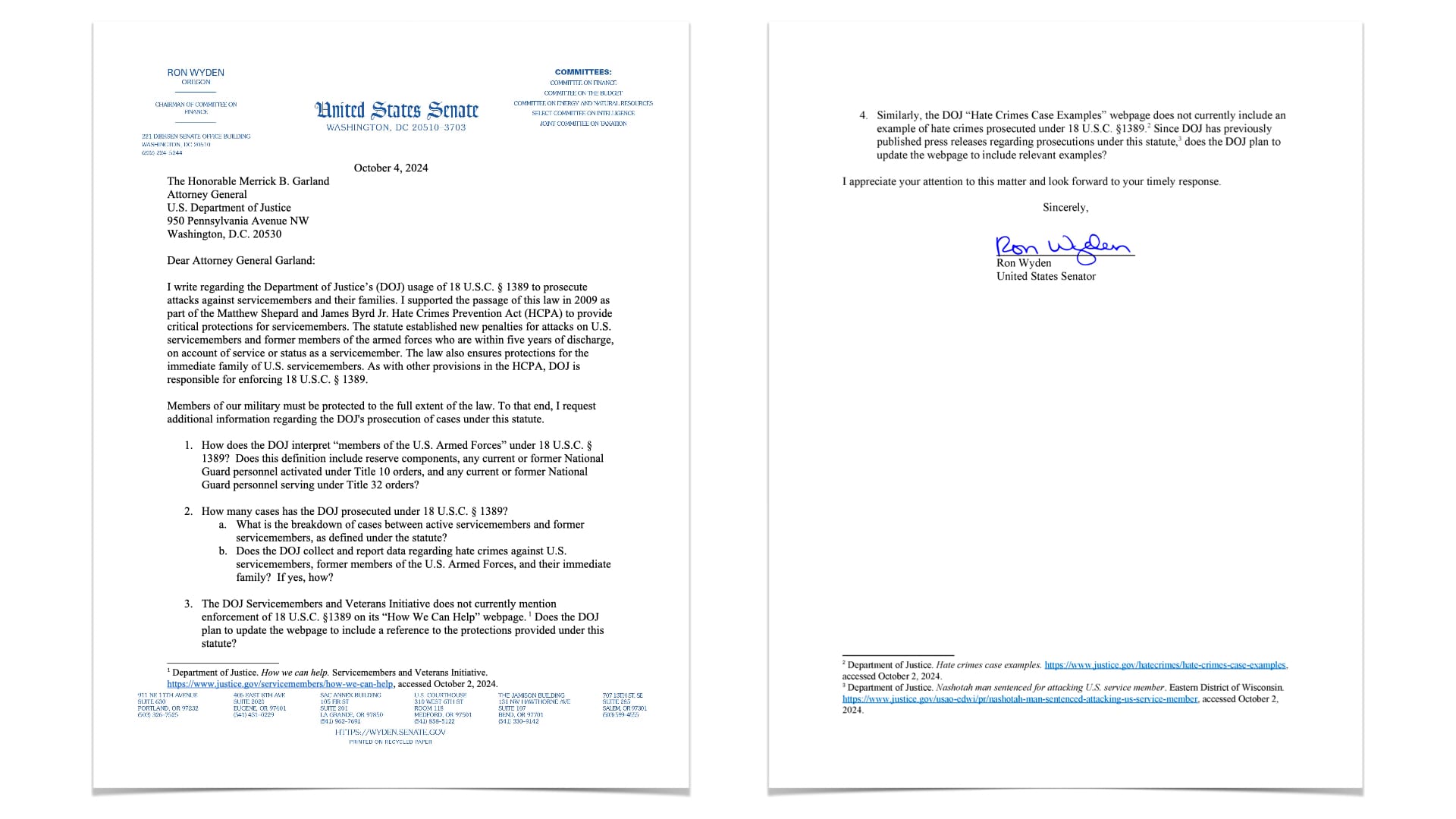
Fifteen years later, that statute is close to a dead letter. Congress has twice written the Attorney General — William Barr in 2019 and Merrick Garland in 2024 — asking a simple question: how many times has the Department of Justice actually used this law? How does DOJ define "servicemember" for purposes of the statute? Does DOJ even track this data? Both letters note that DOJ's own Servicemembers and Veterans Initiative doesn't mention § 1389 on its public-facing "How We Can Help" page. Neither letter, as far as the public record shows, has produced a public answer.
The case most often cited as proof the law works is Terrence McNeil — the Akron man who, in 2015, posted the names, addresses, and photos of a hundred service members online with an explicit call for ISIS sympathizers to murder them in their homes. If there was ever a textbook § 1389 case, this was it: doxing paired with an unmistakable incitement to violence, against servicemembers, on account of their service. The FBI's own affidavit treated it that way. The original criminal complaint, filed November 11, 2015, names § 1389 in full as one of two federal crimes of violence McNeil was accused of soliciting — quoting the statute's "on account of the military service" language directly and citing it, alongside the general federal-officer statute, § 1114, as the predicate offense underlying the single solicitation charge on which he was first arrested.
Somewhere between that complaint and the guilty plea eighteen months later, the Soldiers Amendment theory faded from public view. McNeil was ultimately convicted on solicitation and interstate-threat counts; the public summaries of that plea don't mention § 1389 by name. Whether it was formally dropped in a later superseding indictment, folded into the broader § 1114 theory, or simply stopped being the count prosecutors talked about — the record I have doesn't settle that. What it does show is this: even in the one case built on a literal kill list naming servicemembers by rank and address, drawn up because of their service, the government's own investigators reached first for the Soldiers Amendment — and by the time McNeil was sentenced, the statute written specifically for this crime was no longer the headline on the case built to punish it.
 Logan M. Isaac
Part of the reason may be structural rather than deliberate. McNeil was ISIS-inspired; his prosecution ran through the National Security Division's counterterrorism section, not the Civil Rights Division's hate crimes apparatus. That split matters for what the Navy notice describes. Its own language — "adversaries," "hostile actors," "coordinated" campaigns — points toward exactly the kind of foreign-linked activity that gets filed as a counterintelligence or terrorism matter inside DOJ, not a civil rights one. If that's the pattern, then the conduct this notice warns 600,000 people about may never be evaluated under the statute Congress wrote to cover it, regardless of what the statute says on its face. The law doesn't care whether the animus is foreign-directed or homegrown. DOJ's org chart, apparently, does.
And even where § 1389 clearly does apply, it applies less than the "equal footing" promise suggests. Race, religion, national origin, and the other classes protected under the same 2009 law carry no expiration date. Military status does: the statute protects veterans for exactly five years after discharge, and not a day more. Nothing in the text explains why animus toward a person's service should fade on a schedule that animus toward their faith or their race does not. The more honest reading isn't that Congress made a considered judgment about risk — it's that the promise of parity was never fully built out.
So here is where that leaves the people this notice was sent to: a documented, escalating pattern of doxing, harassment, and physical intimidation, against a population Congress explicitly said deserved the same protection as any other protected class — met not with prosecution, not with public accountability, not with a Justice Department answering Congress's direct questions about its own enforcement record, but with a memo instructing the targets to make themselves harder to find.
That is not protection. That is the government outsourcing its own deterrent failure to the people it failed to deter anything for. The law promised that attacking someone for their service would carry a federal cost. In practice, the only cost being imposed right now falls on the service members and families being told, in writing, to go quiet about who they are.
Nobody should have to choose invisibility as the price of having served.