Put Your Own Mask On First

There's a rule in Combat Lifesaver training that runs against every instinct you have as a soldier: self-aid before buddy-aid. If you're bleeding out, you treat yourself first. Not because your life matters more than your buddy's. Because you'll be dead before you finish their tourniquet if you don't.
The oxygen mask on the airplane works the same way. The flight attendant isn't telling you not to love your kid. They're telling you that a parent who passes out is useless to a child who doesn't know what to do. Get oxygen first. Then help them, even if they're already unconscious.
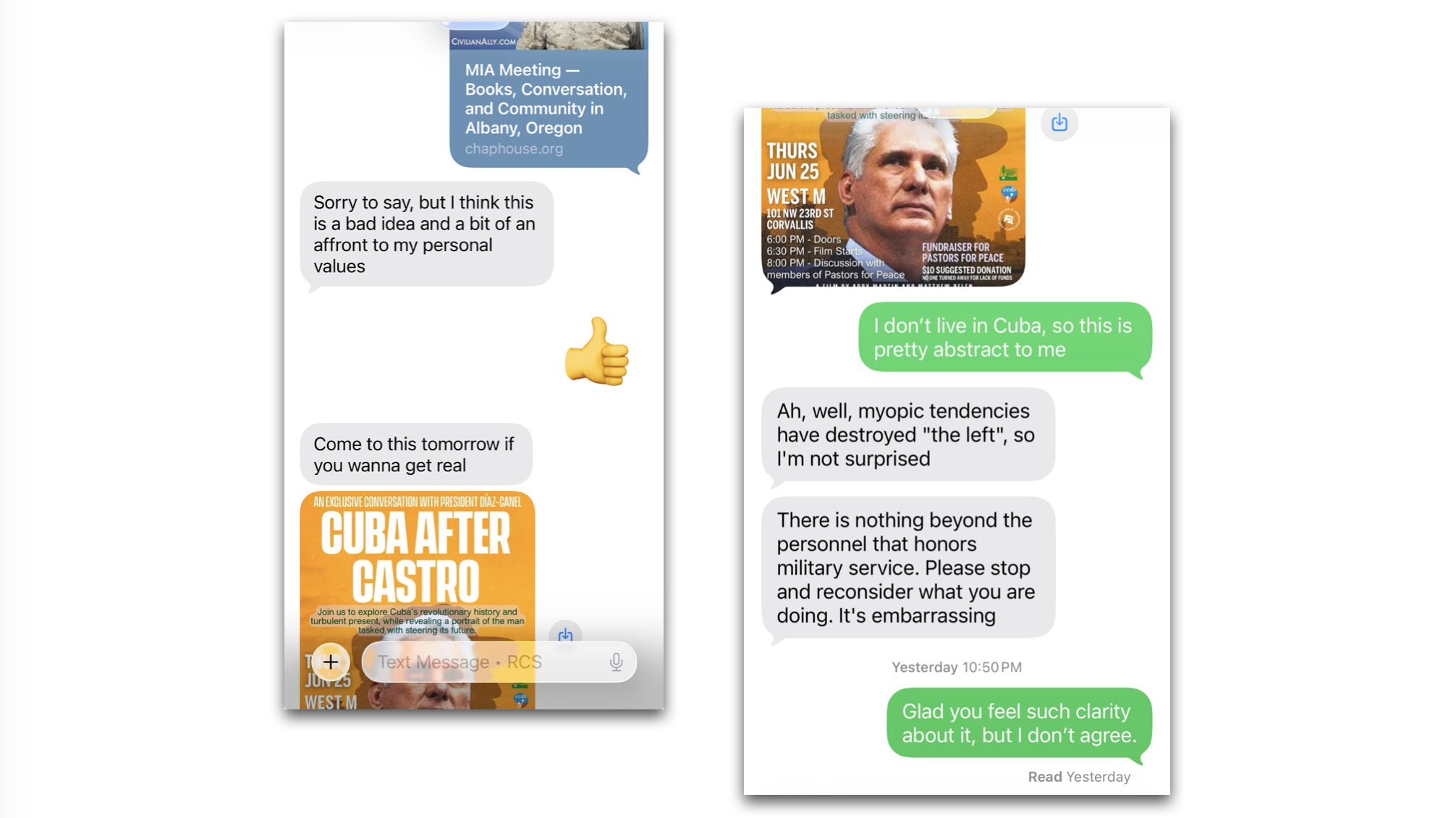
I've been thinking about this logic a lot lately, after a conversation with a fellow veteran who told me my work on military civil rights was "embarrassing" and suggested I come to a Cuba solidarity event instead. He meant well. He's trying to do what progressive veterans do: connect local action to global struggle, push back against the insularity of flag-waving patriotism with something more expansive and humane.
I respect the instinct to spend my privilege on people in need. I spent weeks in Palestine on terminal leave after my ETS, trying to understand what the wars I'd been part of looked like from the other side of the wall. I'm not arguing against international solidarity. I'm arguing about sequence, and about who pays the cost when we get the sequence wrong.
The Problem (as I see it)
Here is the problem as I see it: veteran attention, like veteran bodies, is finite. We burned through a lot of it in service. We don't get it back. And the current political environment is specifically designed (not conspiratorially, but structurally) to overwhelm your capacity for response. The proliferation of causes isn't an accident. When everything is urgent, nothing is. When you're exhausted and guilty about everything you're not fixing, you become easy to influence toward whatever has the most existing infrastructure behind it.
Cuba, apparently, has Pastors for Peace. Palestine has a massive international advocacy ecosystem. These causes are legible, networked, and socially rewarded in progressive veteran spaces. What doesn't have that infrastructure yet is the fight to enforce the Soldiers Amendment — 18 U.S.C. §1389 — a federal hate crime statute passed unanimously in 2009 that has never, in seventeen years, been prosecuted. Not once. Military families are on the books as a protected class. The enforcement gap is the civil rights violation.
That cause has no film screenings. No $10 suggested donation at the door. No conversation with a head of state. It has me, pro se, in federal court in Eugene, Oregon, trying to make the law mean what it says.
I'm not asking anyone to stop caring about other countries. I'm asking: when did you last put your own mask on first?
Asking the uncomfortable question(s)
The same colonizing impulse that sends American power abroad to defend democracy while democracy erodes here at home doesn't belong exclusively to warmakers. It operates just as efficiently in the "peace" industry. The logic is identical: the problem is always somewhere more dramatic, more photogenic, more globally legible than the thing happening in your own community, to your own people, under your own nose. And the people who build careers and organizations and social capital around directing your attention to that more dramatic problem are not always wrong about the problem, but they are benefiting from your gaze being pointed away from introspection, away from local interests and local accountability.
This isn't cynicism. It's arithmetic. Finite resources flow toward visible causes. Visible causes have advocates who made them visible and whose social capital depends on your attention to their preordained cause. The uncomfortable question worth asking is who benefits from veteran social capital being invested in causes that are already well-resourced, and, more importantly, who benefits from military civil rights remaining invisible?
I don't think my fellow veteran is a tool of the system. I think he's a decent man doing what decent men do when the infrastructure for something closer and scarier doesn't exist yet: he found community where community was available. I understand that. I've done it myself. It's also why veterans were over represented on January 6, 2021; community has become commodified by social capitalists.
I'm trying to build the other thing. The thing without the film screening. The thing that requires you to sit with the fact that our own community's civil rights are being violated right now, in the country that put us in uniform, under a law that was supposed to protect us, while we're looking at a poster for a Cuba documentary.
Put your own mask on first. Not because you don't care about the person next to you. Because you'll be no good to anyone if you don't.